The Regional Campus Tirur is one of the earliest Regional Campuses established by the University. The Regional Campus started functioning in a temporary building at Thunjanparamb near Tirur in November 1993 with Post Graduate and Under Graduate courses. The Campus, later shifted to Tirunavaya is now located in an area of great historical and cultural importance.Though the campus could provide quality education to the students from the socially and economically backward areas of Malappuram District, the main deterrence for its development was the non-availability of required piece of land for the construction of building. This hindrance was overcome with the generosity and social commitment of Mr. P Padmanabhan alias Unni (Manager, Navamukunda Higher Secondary School, Tirunavaya) who donated three acres of land at Tirunavaya near the school.
In June 2007, Sri. M. A. Baby, Minister for Education opened the building for the student community. The new Academic Block is named “Padmanabhan Nair Memorial Academic Block” in commemoration of the father of Sri. Pamanabhan alias Unni. The naming was done by Sri. Paloli Muhammed Kutty, Minister for Local Self Government in a function presided by Dr. K.S. Radhakrishnan, Vice Chancellor of the University.
Type: PG
Duration(in Years): 2
Evaluation: Credit
Intake: 10
Mode: Regular
UG
Syllabus:
Not AvailableType: PG
Duration(in Years): 2
Evaluation: Credit
Intake: 20
Mode: Regular
Any Degree
The year 1994 was a path-breaking year as far as Sree Sankaracharya University is concerned, as the university which was then a reservoir for various Indian languages decided to conceive something so alien as English while establishing a masters degree for the same. This programme is designed to reflect the knowlegde of theories, concepts, techniques and technologies in the human and cultural aspects of English. The study of English covers a broad spectrum ranging from the conventional study of language and literature to such complex discourses as Cultural Studies, Human Discourse studies, etc. In the globalized context of language studies, language has lost many of its functions. The only function of language largely unaffected by globalization is the communicative function. In this changed scenario, proficiency in communication skills has become an essential qualification for employment. Irrespective of the discipline, mastery in communication enhances employability skills of prospective candidates. Courses have been designed in such a way as to cater to the essential contemporary needs of the students.
Syllabus:
View SyllabusType: PG
Duration(in Years): 2
Evaluation: Credit
Intake: 30
Mode: Regular
A recognized 3-year Undergraduate degree in any discipline
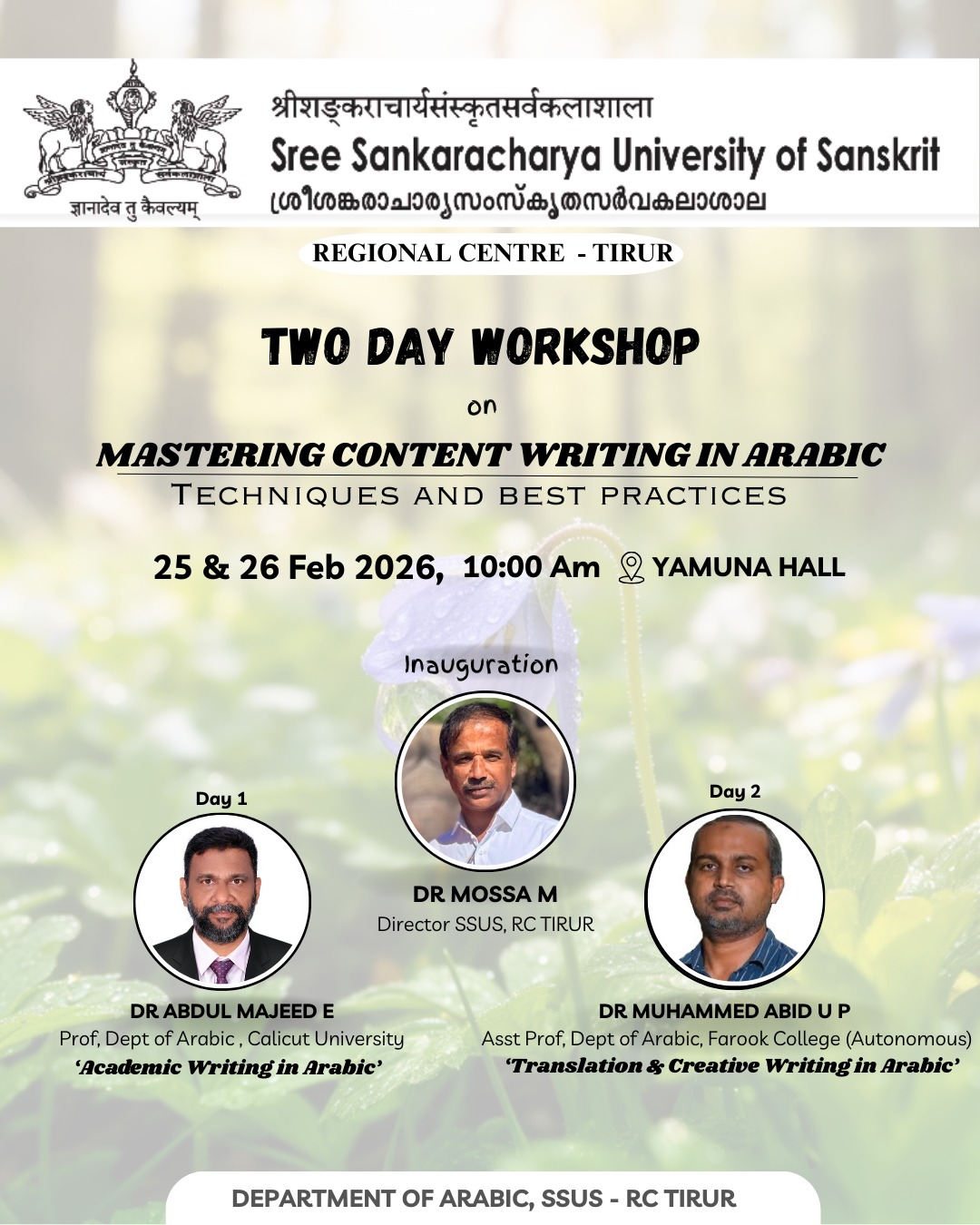
The Master of Arts (MA) in Arabic at Sree Sankaracharya University of Sanskrit, Kalady is a two-year full-time postgraduate degree offered as part of the university’s MA programmes in languages and humanities. It aims to deepen students’ understanding of Arabic language, literature, and cultural studies, preparing them for careers in academia, translation, teaching, research, and global communication. The course typically includes advanced language training, literary analysis, and exposure to classical and modern Arabic texts, and admissions are generally through the university’s entrance process with eligibility requiring a recognized bachelor’s degree. The programme is part of the broader MA offerings at the university, which emphasize language proficiency and cultural insight.
Syllabus:
View SyllabusType: PG
Duration(in Years): 2
Evaluation: Credit
Intake: 20
Mode: Regular
Any Degree
The Department of Hindi offers credit system in M.A course. The duration of the course is 4 semesters with 64 credits. There will be 16 courses and each course carrying 4 credits. Out of 16 courses 11 courses are core papers, one seminar course and 4 are electives. The system of evaluation will be a combination of Internal and external examination. 50% of the credits will be for internal evaluation. Evaluation will be based on 9 point grading system. There will be three components for internal assessment for each course as follows: a. Seminar Presentation b. Assignments c. Mid Semester Examination Other things regarding the valuation will be as per the Regulation for the M.A. Programmes under Credit and Semester System Effective from 2019 admission onwards
Syllabus:
View SyllabusType: PG
Duration(in Years): 2
Evaluation: Credit
Intake: 20
Mode: Regular
Any Degree
he M. A. Programme in History is designed and structured to introduce historical knowledge and enable students to critically engage with the pasts. The focus is on the Ancient, Medieval, Modern, Contemporary, Intellectual, Intersectional, Visual and Material histories of India as well as its constituent regions. It reflects the theories, methodologies, methods, concepts and data for engaging with historical pasts. As a Programme included within the purview of Social Sciences, it will provide expertise to analyze social changes, economic and political transitions, religious transformations, technological changes, literary and artistic productions and other significant domains of knowledge in History. It will provide a platform for preparing students for pursuing research. The Department is part of the Faculty of Social Sciences and offers Degrees at the Master’s (M. A.), and Research levels (M.Phil. and Ph.D.)
Syllabus:
View SyllabusType: UG
Duration(in Years): 4
Evaluation: Credit
Intake: 20
Mode: Regular
Plus Two
**FYUGP Sanskrit Vyākaraṇa** is an introductory programme designed to provide students with a strong foundation in Sanskrit grammar. It familiarizes learners with the basic principles of Vyākaraṇa such as *saṁjñā*, *sandhi*, *subanta* and *tiṅanta* forms, *kāraka*, *samāsa*, and sentence structure, following the Pāṇinian grammatical tradition. The course develops linguistic accuracy, analytical thinking, and the ability to read and understand simple Sanskrit texts, preparing students for advanced study, research, and practical applications of Sanskrit language and literature.
Syllabus:
View SyllabusType: UG
Duration(in Years): 3
Evaluation: Credit
Intake: 20
Mode: Regular
Plus Two
Syllabus:
Not AvailableType: PG
Duration(in Years): 2
Evaluation: Credit
Intake: 10
Mode: Regular
Any Degree
The Department of Sanskrit Vyākaraṇa of Sree Sankaracharya Sanskrit University has designed the 'Ācārya' (Postgraduate) programme in 'Sanskrit Vyākaraṇa' with the aim of enabling students to gain a scientific and systematic understanding of the Pāṇinian grammatical system. The programme seeks to impart deep and comprehensive knowledge of the science of grammar. Through the study of texts such as the 'Aṣṭādhyāyī', 'Mahābhāṣya', 'Vākyapadīya, 'Kāśikā', 'Siddhāntakaumudī', various 'Prakriyā-granthas', the works of 'Nāgeśa', and treatises on 'Śābdabodha', students are trained thoroughly in the discipline of Vyākaraṇa. Special emphasis is also given to understanding the significant contributions of Kerala to the tradition of Sanskrit grammar. The programme further highlights the historical development of grammatical science, its relationship with linguistics, and its interaction with other branches of knowledge. Through the study of grammatical and linguistic thought in Sanskrit, students attain intellectual sharpness, clarity of understanding, and refinement of reasoning.
Syllabus:
View SyllabusType: UG
Duration(in Years): 4
Evaluation: Marks
Intake: 120
Mode: Regular
Plus two
Syllabus:
Not AvailableType: PG
Duration(in Years): 2
Evaluation: Credit
Intake: 120
Mode: Regular
Any Degree. Based on the national level entrance examination.
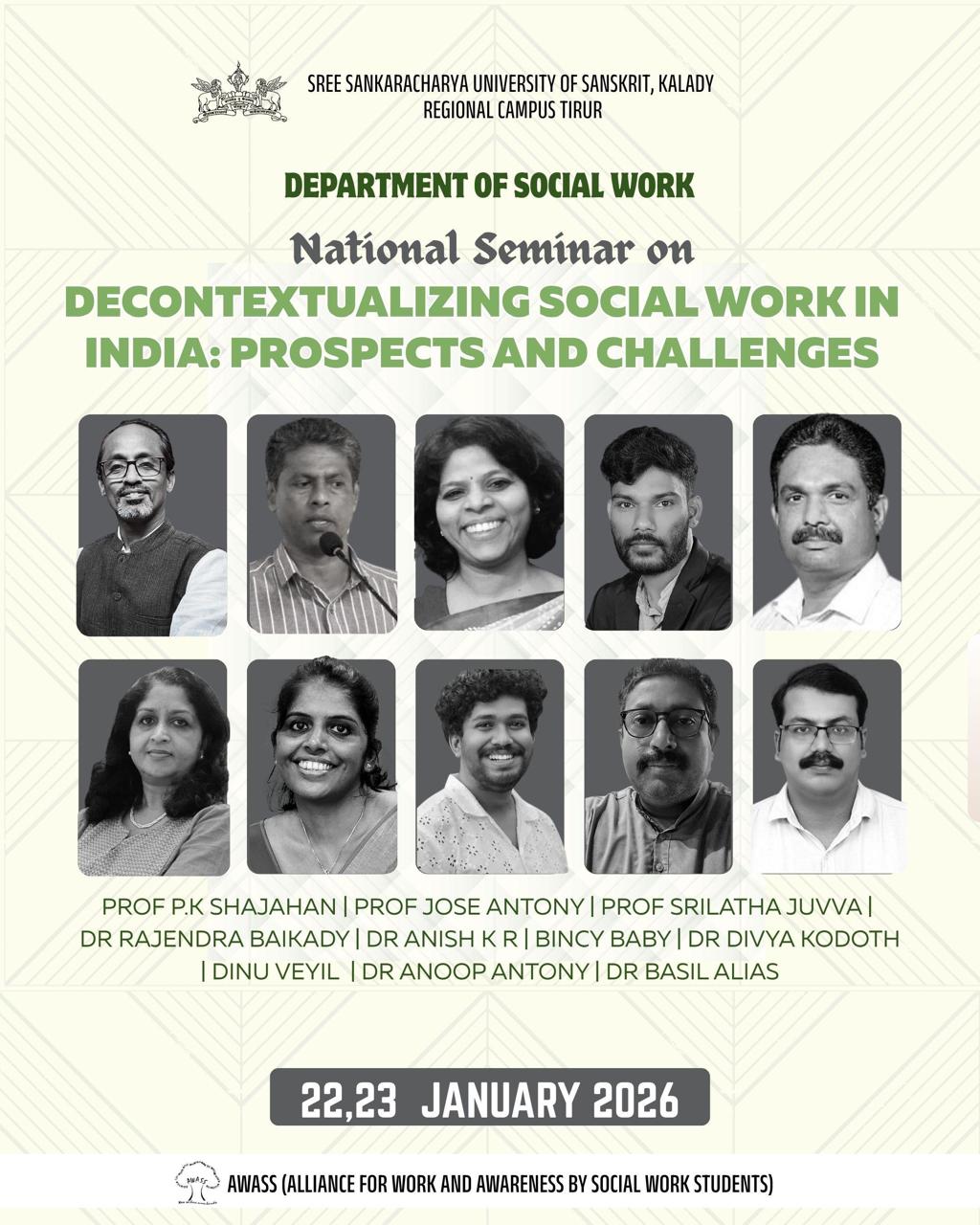
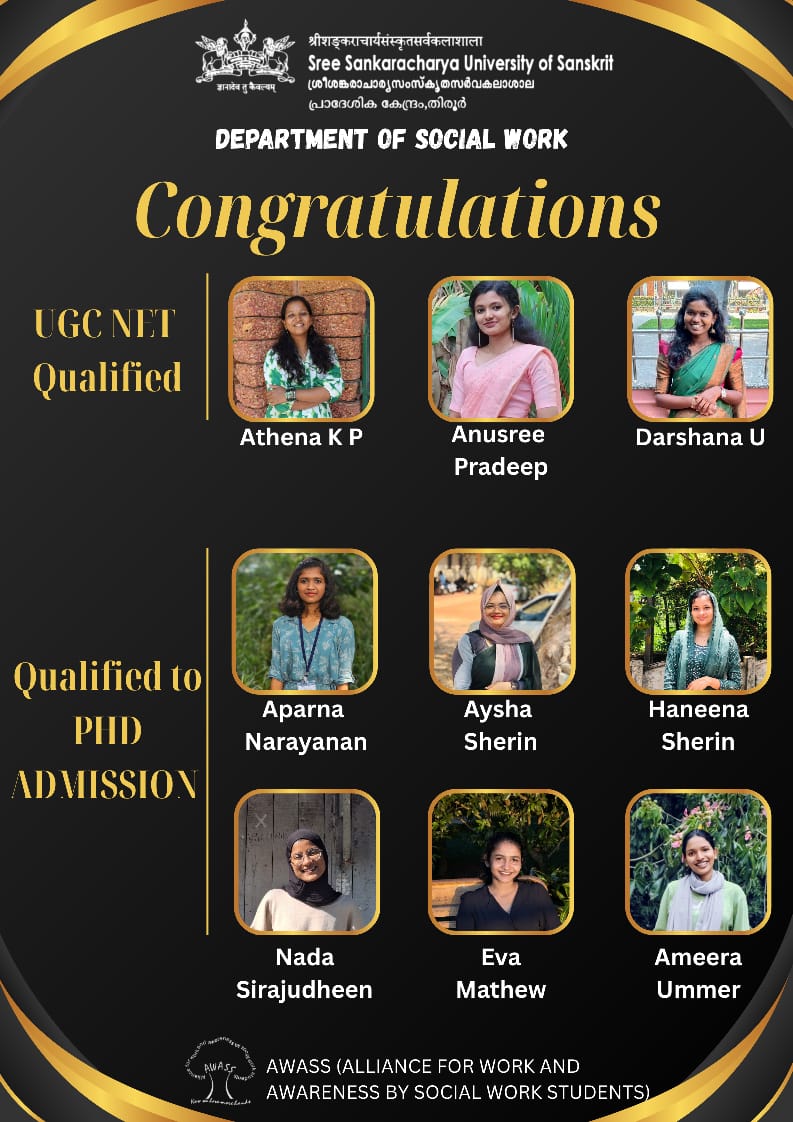
The Social Work programme offers interdisciplinary academic and research possibilities that critically opens up local and global discourses on health, development and marginalization, gender, and family, identity, rights and justice. The field practicum component, which is an integral part of the MSW curriculum, offers opportunities for the students to spend time in close proximity with communities, NGOS and various social movements. Such close association lays the foundation for critical and alternative perspectives on one’s own society. The course thus will provide the students with strong theoretical underpinnings and expose them to the dynamics and complexities of the social world. The Social Work discipline and profession aims at planning and implementation of social policies, services and programmes needed to meet basic human needs and to support the development of human capacities and abilities. It facilitates change (1) within the individual in relation to his/her social environment; (2) of the social environment in its effect upon the individual; (3) of both the individual and social environment in their interaction. The ultimate aim of social work is to promote or restore a mutually beneficial interaction ‘inter’, ‘intra’ individual, and society in order to improve the quality of life for everyone.The post graduate programme offered by the Department (MSW) is recognized by the social work accreditation councils of UK, USA, Australia, Canada, and New Zealand. Our students get their recognitions and accreditations in these countries on the basis of the verification of the course modules they have done in the University and the field practicum they have done here in the programmes.
Syllabus:
Not Available